Lumis
A modular stack of curated volatility-harvesting vaults — Nova, Astrid, Polaris, and Inception — synchronized by an app-specific sequencer for MEV-protected hedging on Uniswap V4
Contents
Summary Thesis Modular curated vaults Sequencer Market opportunity Protocol Nova Astrid Directional vault Delta-neutral vault Astrid performance Astrid risks Polaris Delta-neutral Polaris Directional Polaris Polaris risks Inception Inception performance Inception risks App-specific sequencer Use case Business modelSummary
Thesis
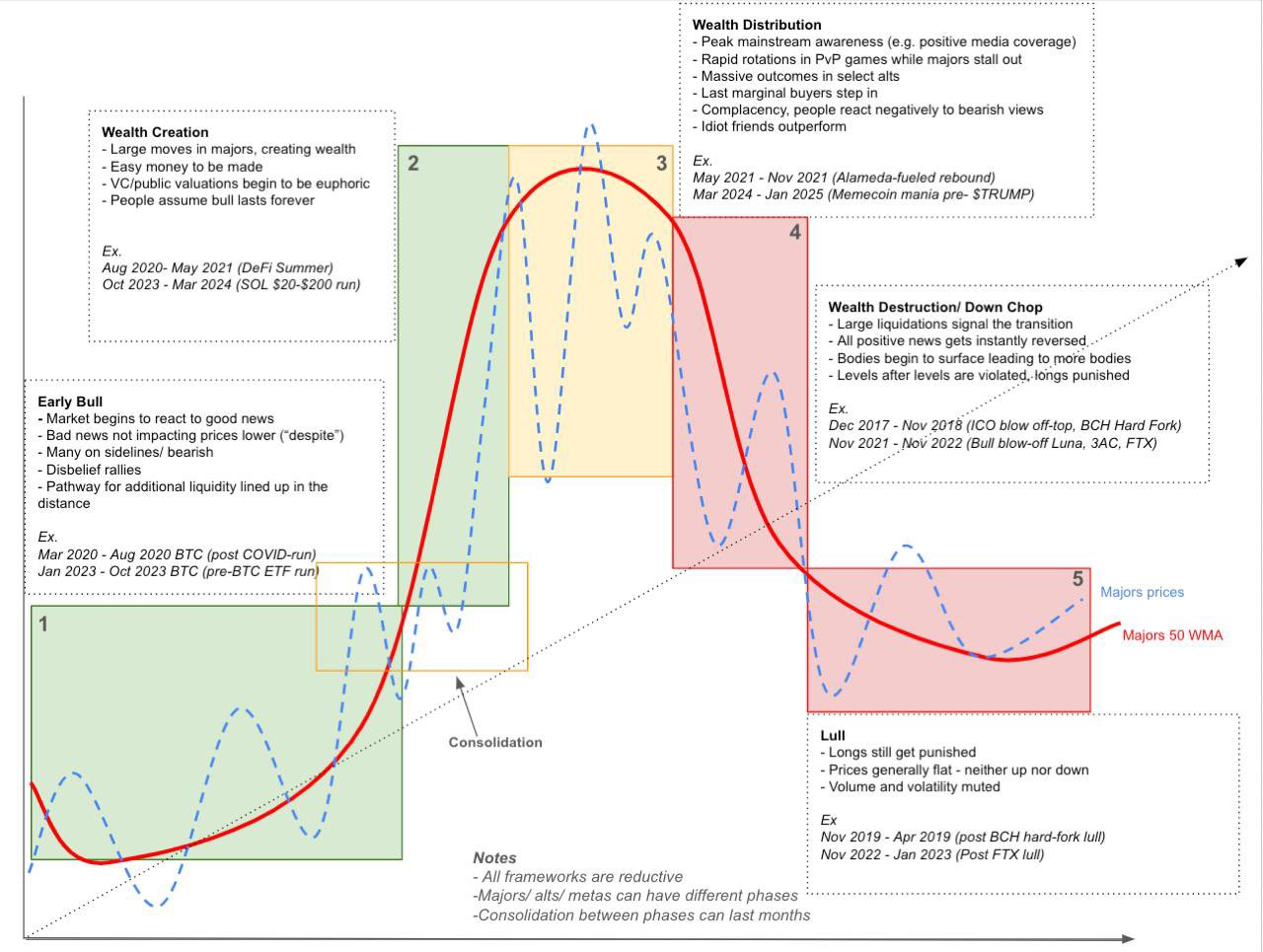
- Benchmark: BTC is the benchmark of crypto markets — consistently outperforming it is challenging even for sophisticated liquid funds.
- Volatility harvesting: solving the impermanent loss problem unlocks a massive, scalable, and sustainable yield source that capitalizes on both long-term growth (black line) and high mid- and short-term market volatility (red and blue lines).
- Solution: with Uniswap V4 hooks and integration across spot, lending, and derivatives markets, Lumis provides infrastructure that effectively translates fragmented risk into highly composable yield opportunities for both directional and delta-neutral LPs.
Modular curated vaults
Lumis enables professional managers (curators) to permissionlessly deploy all of the presented directional and delta-neutral structured vaults, tailored to specific risk-yield profiles:
- Nova:
- Yield optimizer that supplies capital into Morpho lending markets and reuses it for LPing on Uniswap V4, yielding from both interest rate and trading fees.
- Nova stETH: 6–7% for ETH instead of 3.2% stETH APY.
- Astrid:
- Transforms impermanent loss into manageable, profitable arbitrage through dynamic spot-perp hedging.
- Expected APY: ~15%.
- Polaris:
- Leveraged market-making vault for amplified trading fees (up to 3x) with built-in impermanent loss hedging.
- Expected APY: ~30%.
- Inception:
- All-weather vault with dynamic capital allocation across Nova, Astrid, and Polaris vaults based on market volatility.
- Leverages the mean-reverting nature of volatility to create a balanced and resilient portfolio suitable for diverse market regimes.
- Expected APY: 15–20% for BTC, ETH, and stables.
Sequencer
The core execution engine that coordinates vaults to optimize hedge execution, minimize slippage, and mitigate MEV vulnerabilities:
- Trade balancer: dynamically routes liquidity between vaults to ensure efficient swap execution with minimal slippage.
- Automated hedging: internal netting between directional and delta-neutral vaults to efficiently hedge impermanent loss without incurring excessive external execution costs.
- Global rebalance coordination: enables curators to align their vaults to a coordinated rebalancing schedule (hourly, daily, weekly), optimizing execution via batch auctions.
Market opportunity
- Demand: clear, unmet, growing demand for institutional-grade delta-neutral and directional structured products.
- Protocol: Lumis provides permissionless infrastructure optimized purely for the technical execution of volatility-harvesting strategies, eliminating the performance/scalability bottlenecks.
- Use case: vault curators can deploy customized structured products leveraging our modular vault templates tailored for their clients' needs, while instantly benefiting from network-wide shared trade flow and coordinated rebalancing execution.
- Business model: protocol revenue is generated via trading fee sharing (sequencer-level) with a further token buyback from the open market.
- Scalability: in current market conditions this can be scaled up to $10B TVL — and higher with further acceleration of the DEX–CEX trading volume share driven by optimized liquidity solutions (more liquidity → better execution → higher volumes → higher fees).
Protocol
BTC has established itself as the crypto benchmark asset, yet consistently outperforming it remains challenging even for sophisticated liquid funds. With rising institutional adoption, demand for structured crypto yield products is rapidly accelerating.
Volatility harvesting — capturing yield from interim volatility rather than directional bets alone — has become critical for sustainably outperforming benchmarks. Recent market validation (such as Ethena's yield-bearing USDe) signals significant demand for structured yield products.
However, one critical source remains largely untapped: sustainable spot-trading fee yield harvesting. Current DeFi solutions have struggled to effectively manage impermanent loss and technical execution bottlenecks — leaving billions in yield on the table.
Lumis solves this missing piece by providing permissionless infrastructure that integrates spot, lending, and derivatives markets. By leveraging Uniswap V4 hooks and automated, synchronized hedging, Lumis enables institutional-grade structured vaults optimized specifically for capturing volatility-driven trading fees — at massive scale.
This is the next logical evolution in volatility harvesting infrastructure, positioned perfectly at the current moment to capitalize on increasing institutional adoption and clear demand signals for both directional and delta-neutral structured products.
Nova
Nova is a low-risk yield optimizer designed to maximize returns for stablecoin and pegged asset pools while ensuring 100% liquidity availability.
Problem / background
Traditional stablecoin pools in AMMs lock up significant capital, generating a minimal 1–2% yield. At the same time, the USDC interest rate on lending protocols fluctuates in a 5–15% range, depending on market demand. Nova addresses this market inefficiency by combining both interest rate and trading fee yield sources.
Mechanism
Powered by Uniswap V4 hooks, Nova supplies 100% of funds as collateral on a lending protocol and further reuses it to provide liquidity for Uniswap trading pools. With this liquidity rehypothecation, LPs earn both interest rates and trading fees, significantly boosting LP performance.
For example, in the case of the USDC-USDT pool:
- The contract deposits both USDC and USDT to Earn vaults (Morpho USDC and Morpho USDT vaults) on lending protocols.
- For the USDC → USDT swap operation:
- We receive USDC from the user.
- Supply the received USDC to the lending protocol vault.
- Calculate the USDT output amount.
- Withdraw this amount from the lending protocol.
- Send USDT to the user.
This flow ensures no idle funds, with 100% of capital deployed into the Morpho lending protocol while implementing on-demand liquidity that withdraws funds only when trades occur.
This rehypothecation design won a Morpho grant under MIP-93 — Call for Grants: the winning proposal (December 2024) lays out the on-demand deposit/withdrawal swap flow for Nova, then named UniCord.
Use cases
- sUSDe-DAI. Curators can create a custom Nova vault for any yield-bearing asset that is looking for additional spot and lending market liquidity. For example, for the sUSDe-DAI pool, managers can create a Nova vault that will deposit DAI into the Spark DAI Earn Vault on Morpho and sUSDe into a sUSDe-DAI lending market. This way, the Nova vault creates more liquidity simultaneously for both the sUSDe and DAI lending markets and the sUSDe-DAI liquidity pools on Uniswap V4, enabling more efficient execution of looping strategies for higher returns.
- stETH-WETH. Staking providers can offer their institutional clients a self-rebalancing portfolio of stETH-ETH positions, aggregating multiple yield sources. Powered by the upcoming Lido V3 stVault Platform, the flow is the following:
- Curators (staking providers) deploy a custom Nova stETH-ETH vault by specifying:
- designated lending vault addresses to supply stETH and WETH assets;
- the target Lido V3 stVault.
- Clients deposit WETH:
- a helper contract automatically stakes 50% of the received WETH into the target stVault;
- Nova supplies the stETH and WETH funds to the designated lending vaults;
- Lumis aggregates all the custom stETH-ETH Nova vaults for integration into the shared trade flow from our app-specific sequencer, avoiding liquidity fragmentation. This is especially important in the context of Uniswap V4 hooks, where the shared trade flow from the Uniswap router/front-end is no longer guaranteed and hook developers must work independently on their integrations into the DeFi ecosystem. We handle this problem.
- Curators collect multiple yield sources:
- revenue sharing from Lido V3;
- stETH rewards ~3.2%;
- interest rate: stETH ~2.81%, WETH ~2.59%;
- trading fees ~1.5%;
- total expected APY: ~6–7%.
- Curators (staking providers) deploy a custom Nova stETH-ETH vault by specifying:
With Lumis offering all the necessary infrastructure for vault deployment, aggregation, and further integration into the shared trade flow, curators can focus on direct client relationships, avoiding infrastructure development and maintenance.
Astrid
A dual-vault system that executes a tokenized spot-perp arbitrage strategy by providing liquidity on Uniswap V4 and dynamically hedging impermanent loss with Opyn's perpetual futures.
Problem / background
Hedging impermanent loss (IL) is a real challenge. To solve it, ideally you need to hedge/adjust your portfolio as quickly as possible — perfectly, in the same transaction as the swap occurs. Any delay in hedging results in MEV vulnerabilities that can be easily extracted.
Mechanism
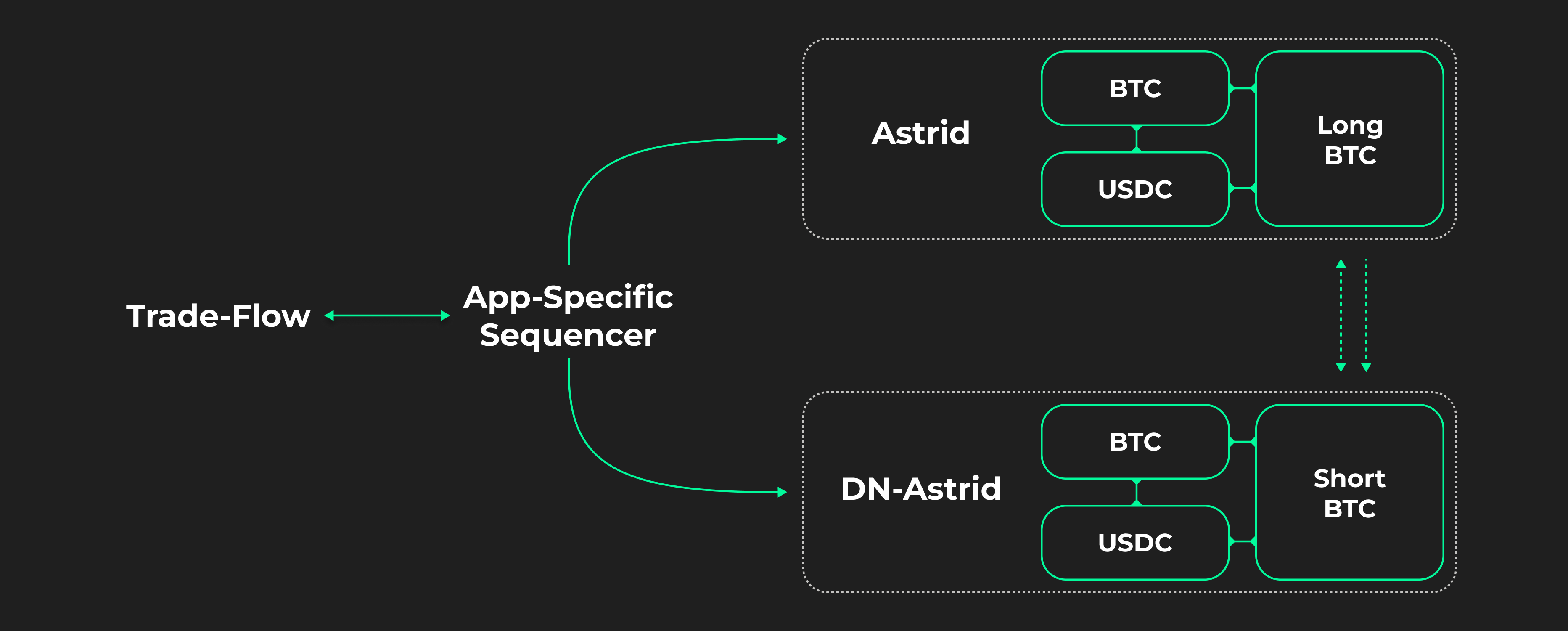
For this, we employ a dual-vault system of two Uniswap V4 hooks that provide liquidity and atomically hedge positions to create synthetic directional and delta-neutral vaults without exposing them to potential MEV attacks.
Directional vault
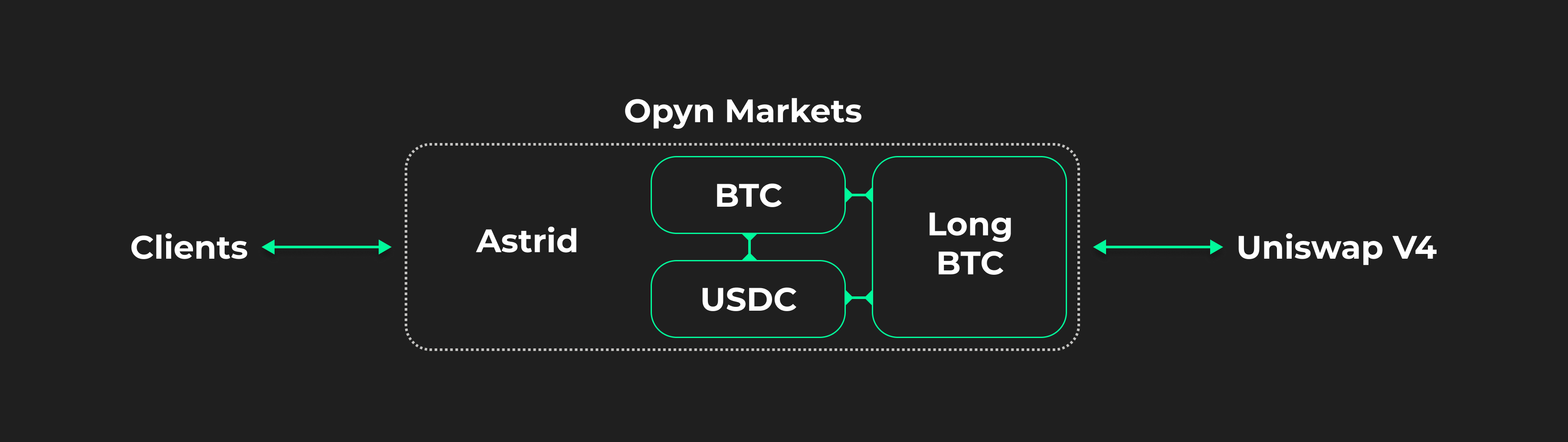
- Accepts BTC.
- Partially converts to USDC.
- Supplies BTC & USDC as collateral to Opyn derivatives markets.
- At the same time, reuses the BTC & USDC to provide liquidity on Uniswap V4.
- Dynamically borrows USDC to hedge impermanent loss by adjusting a long BTC perp position:
- borrow USDC against the BTC & USDC collateral;
- buy a long BTC perp.
- Posts the long BTC perp position back to Opyn markets as collateral (cross-margin).
This way, we effectively execute a spot-perp arbitrage strategy by moving back and forth between spot BTC and BTC perps:
- Revenue: Uniswap trading fees.
- Expenses: USDC borrowing cost, long perp funding rate, slippage on rebalances.
To minimize slippage on rebalances, we match the directional BTC vault with a mirroring delta-neutral vault that provides liquidity on Uniswap V4 but goes short instead of long.
Delta-neutral vault
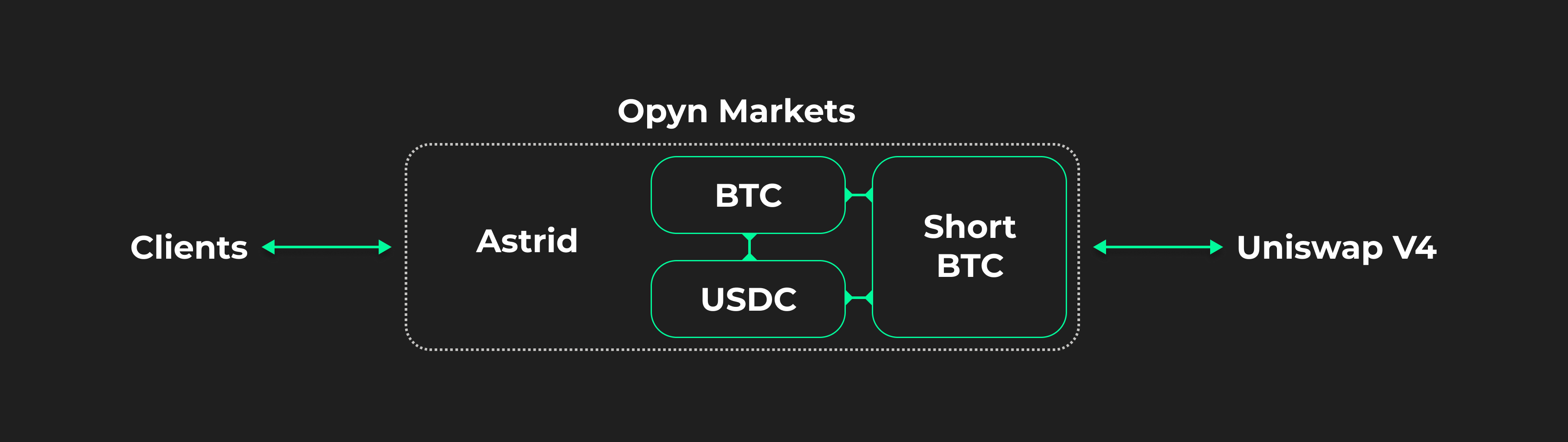
- Accepts USDC.
- Partially converts to BTC.
- Supplies BTC & USDC as collateral to Opyn derivatives markets.
- At the same time, uses the BTC & USDC to provide liquidity on Uniswap V4.
- Dynamically borrows USDC to open a short BTC perp position and hedge impermanent loss.
- Posts the short BTC perp position back to Opyn markets as collateral (cross-margin).
Astrid performance
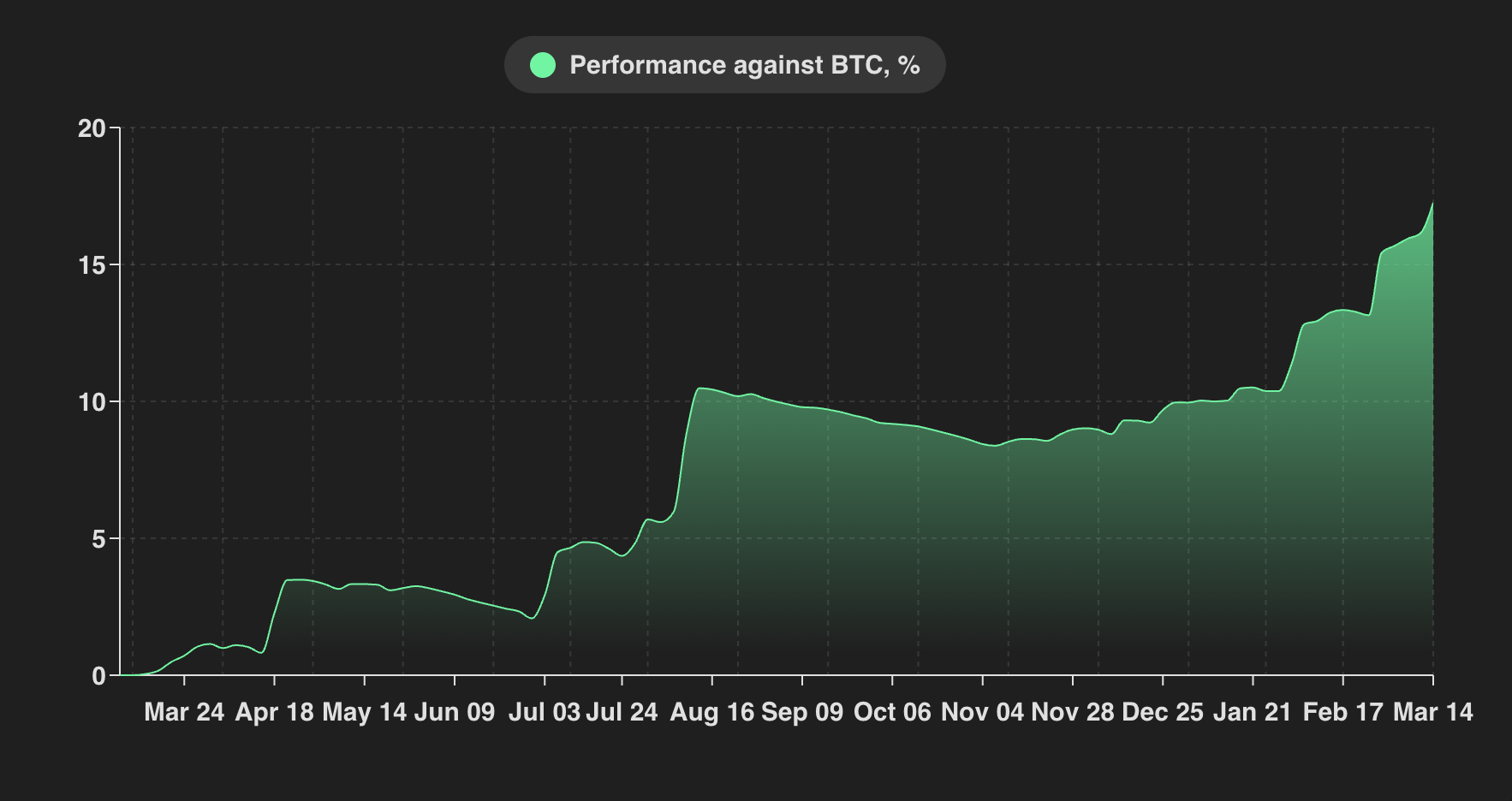
Backtested performance over the last year (March 2024 – March 2025) is 16.8% for both directional and delta-neutral vaults due to their spot-perp arbitrage nature. The strategy performs best during highly volatile markets, as we collect a lot of trading fees from Uniswap.
Astrid risks
Astrid vaults utilize dynamic spot-perp arbitrage strategies and therefore inherently involve:
- Basis risk: temporary price divergence between spot and perpetual markets can impact hedging effectiveness.
- Liquidation risk: leveraged perpetual positions can face liquidation risk under extreme market volatility conditions.
- Execution & slippage risk: hedging execution may incur slippage during volatile market conditions, affecting profitability.
To effectively manage and mitigate these risks, Astrid employs the following measures:
- Real-time automated hedging: our app-specific sequencer immediately hedges impermanent loss internally by synchronizing directional and delta-neutral vaults, significantly reducing external trade execution and minimizing slippage.
- Conditional rebalancing:
- Time-based: scheduled rebalancing once every 7 days.
- Price-based: triggered by underlying asset (BTC) price movements exceeding ±15%.
- Collateral management: positions are collateralized through integrated cross-margining systems, optimizing capital efficiency while maintaining liquidity buffers against potential liquidation.
Collectively, these measures enable Astrid vaults to provide resilient, institutional-grade spot-perp arbitrage strategies while actively controlling inherent strategy risks.
Polaris
Synthetic directional and delta-neutral vaults powered by leveraged market-making strategies.
Problem / background
A high-risk/reward synthetic vault for leveraged trading fee farming with built-in impermanent loss hedging.
Mechanism
A combination of leveraged long and short positions achieved via looping, with further liquidity provision on Uniswap V4.
More liquidity → higher fees → higher APY.
Delta-neutral Polaris
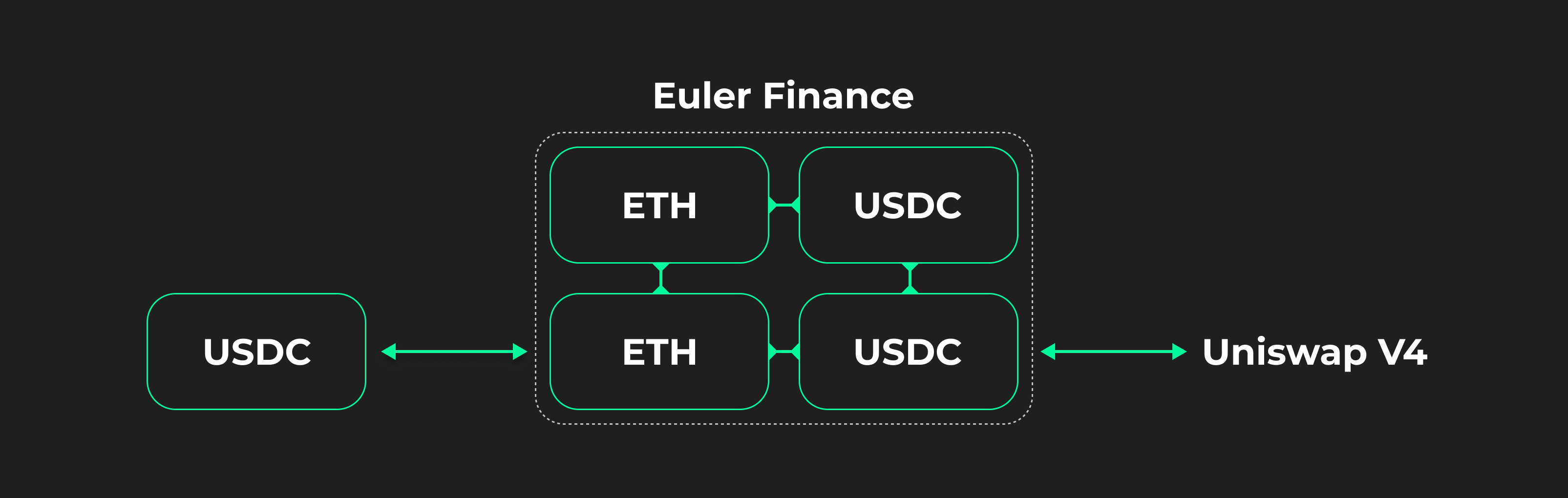
- Accepts USDC.
- Partially converts to ETH.
- Opens leveraged long 2x and short 2x positions via looping.
- Uses the collateral and debt state to provide liquidity for the ETH-USDC pool.
- For the USDC → ETH swap:
- Receive USDC.
- Partially repay the long position's USDC debt.
- Calculate the ETH output amount.
- Remove ETH from the collateral.
- Send ETH to the user.
- For the ETH → USDC swap:
- Receive ETH.
- Increase the long position's ETH collateral.
- Calculate the USDC output amount.
- Increase the USDC debt.
- Send USDC to the user.
Performance
This mechanism results in a delta-neutral portfolio with effective impermanent loss mitigation.
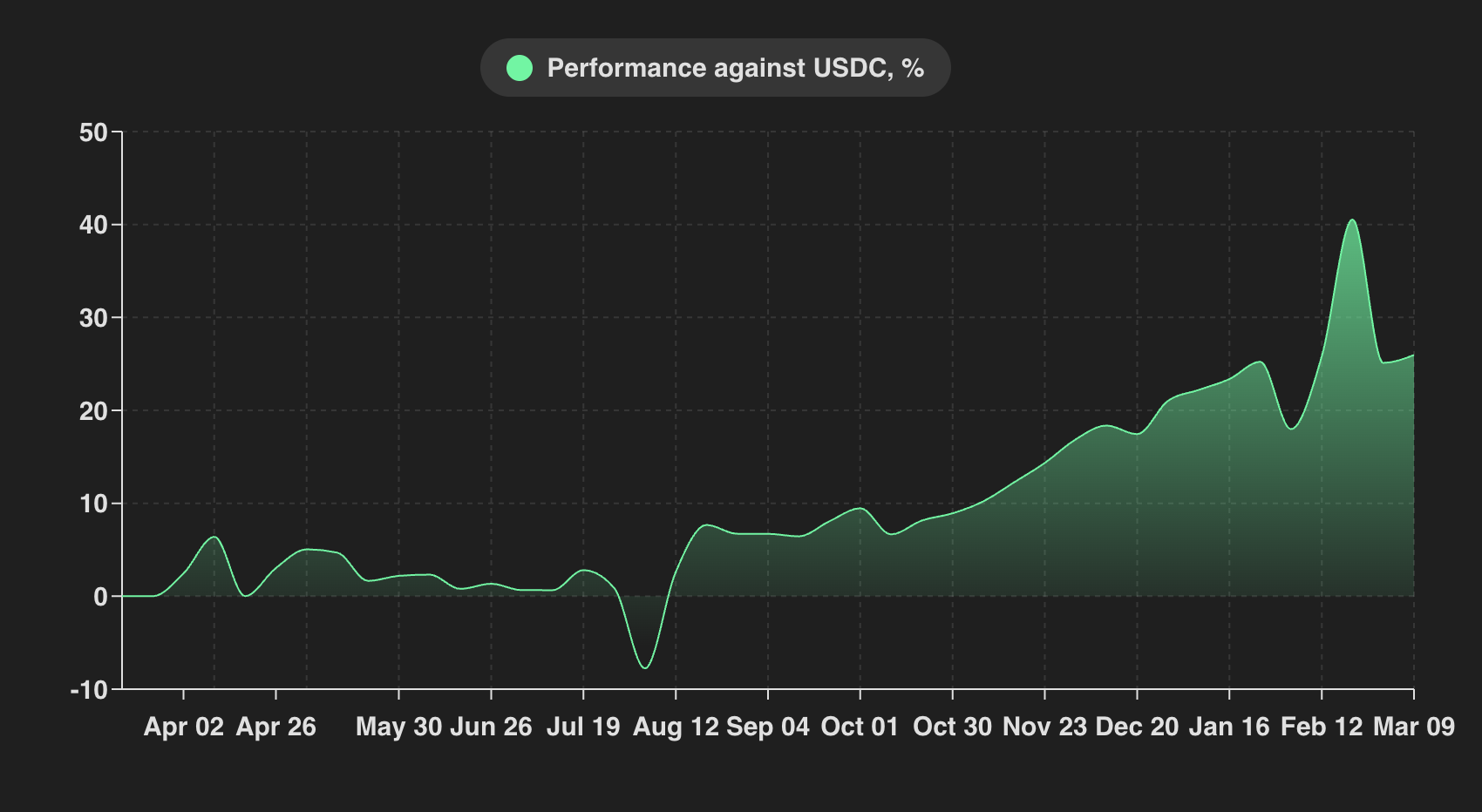
Backtested performance over the last year (March 2024 – March 2025) is 25.8% against USDC.
This strategy performs best during volatile bull markets, where we collect a lot of trading fees — as during the post-election surge. In low-volatility crab markets, we remain within the profitability range and simply keep collecting trading fees.
Directional Polaris
For the directional Polaris vault, we use a combination of a leveraged long 3x and short 2x position, resulting in a net exposure of 1x.
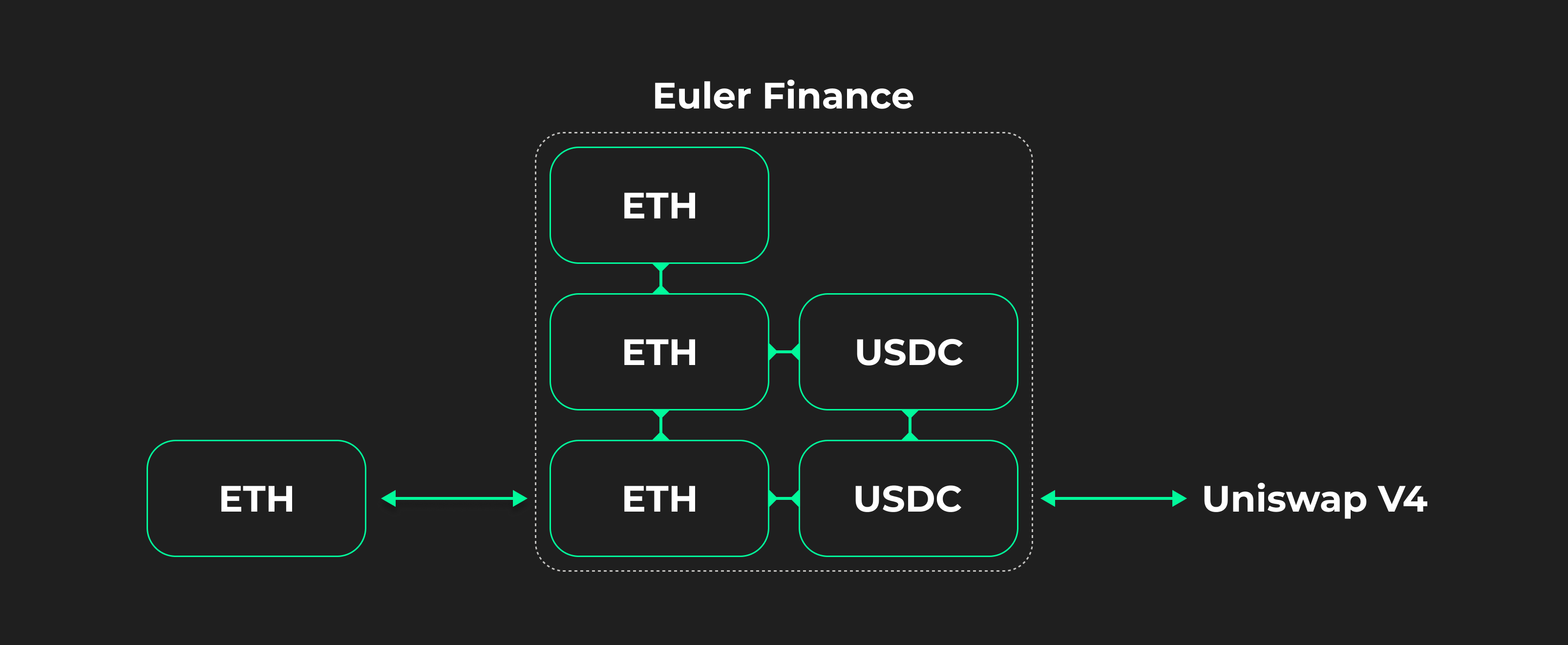
- Accepts ETH.
- Partially converts to USDC.
- Opens a leveraged long 3x and short 2x position achieved via looping.
- Uses the collateral and debt state to provide liquidity for the ETH-USDC pool.
- For the USDC → ETH swap:
- Receive USDC.
- Partially repay the long position's USDC debt.
- Calculate the ETH output amount.
- Remove ETH from the collateral.
- Send ETH to the user.
- For the ETH → USDC swap:
- Receive ETH.
- Increase the long position's ETH collateral.
- Calculate the USDC output amount.
- Increase the USDC debt.
- Send USDC to the user.
Performance
This provides a synthetic ETH vault that earns 3x more trading fees while effectively mitigating impermanent loss.
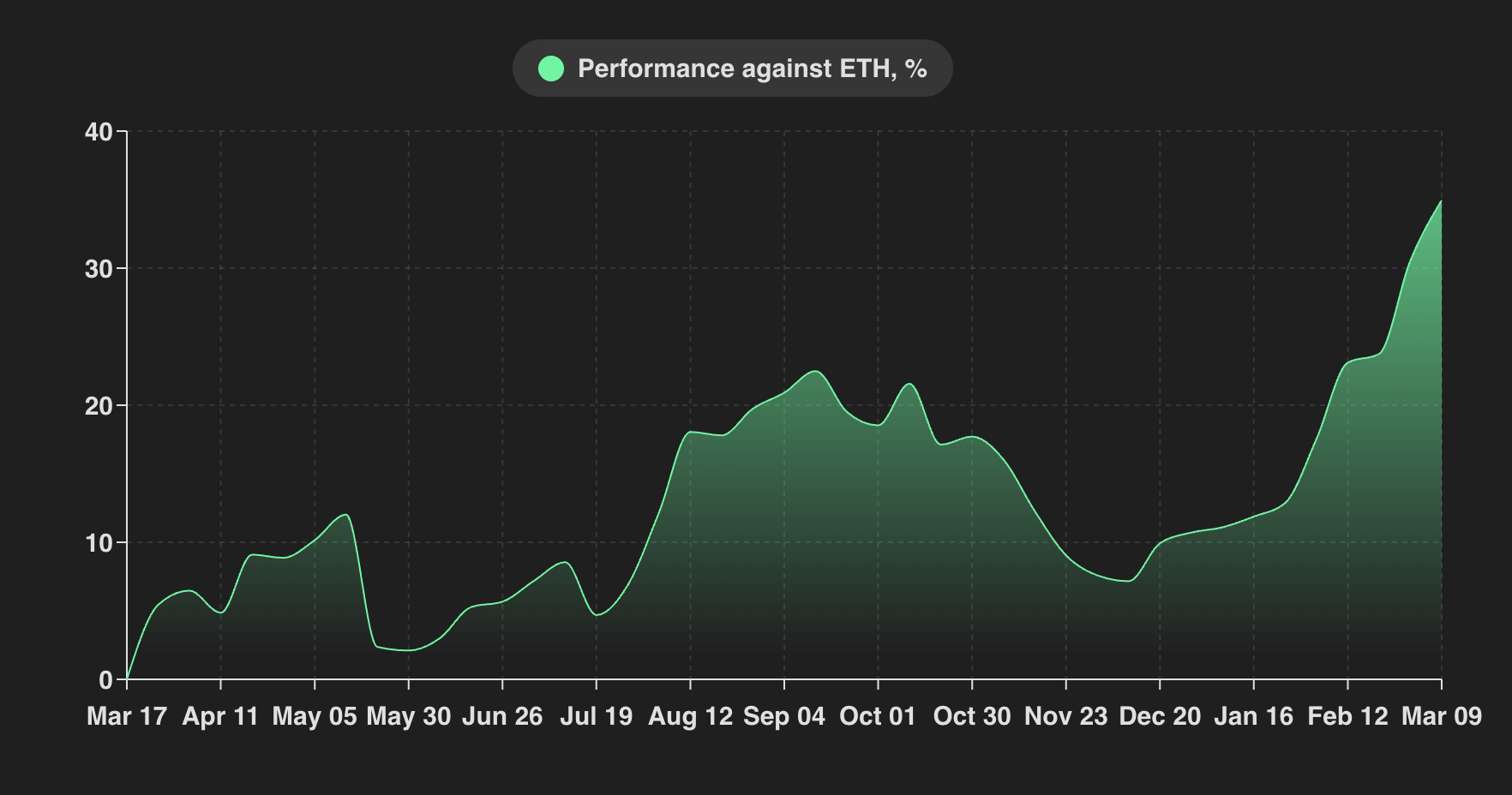
Backtested performance over the last year (March 2024 – March 2025) is 34% against ETH.
This strategy performs best during volatile and fast bull markets: we collect a lot of trading fees while maintaining full directional exposure, gaining from both underlying price growth (ETH) and amplified Uniswap trading fees.
Polaris risks
Polaris provides significantly higher LP returns through leveraged positions, inherently exposing it to liquidation risk.
To proactively manage and mitigate this risk, we apply:
- Dynamic collateral/debt optimization: the strategy atomically shifts collateral and debt between long and short legs during swaps, optimizing loan-to-value (LTV) ratios to maintain vault stability.
- Conditional rebalancing:
- Time-based: rebalance executed every 3 days.
- Price-based: triggered upon ETH price shifts exceeding ±10%.
Together, these measures ensure that Polaris vaults effectively maintain targeted synthetic exposure, minimize impermanent loss, and systematically protect capital against liquidation scenarios.
Inception
An all-weather vault that dynamically allocates funds across Nova, Astrid, and Polaris based on real-time volatility market regimes.
Problem / background
Crypto markets experience constantly shifting volatility regimes, making static strategies ineffective over long periods. LPs and institutional allocators seek adaptive solutions that automatically balance risk and yield opportunities to consistently outperform benchmarks like BTC or USD under diverse market conditions.
Mechanism
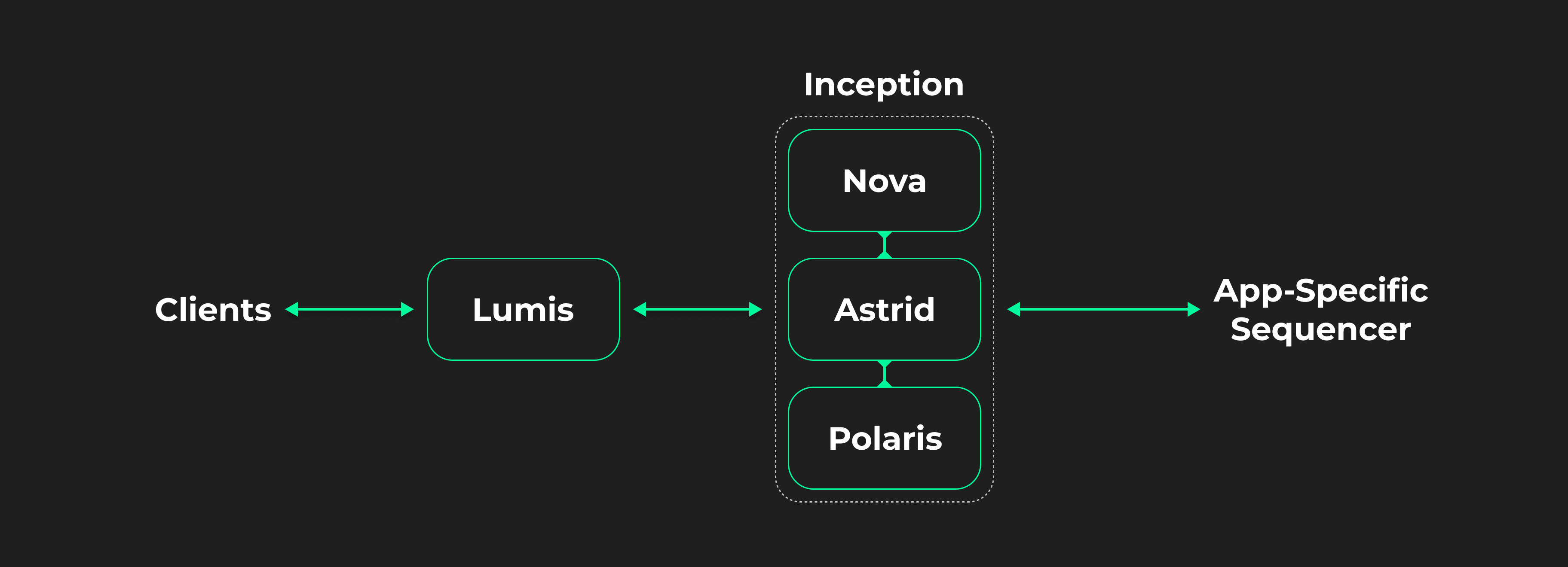
The Inception vault dynamically deploys capital across Lumis' curated vault suite (Nova, Astrid, Polaris). It utilizes mean-reverting market volatility to efficiently shift allocations based on market conditions:
- High-volatility (risk-off): shifts capital into conservative Nova vaults (stablecoins) for capital protection, capturing heightened yield from lending/funding rates and spot liquidity fees.
- Medium-volatility: balances capital allocation, relying on Astrid's spot-perp arbitrage strategy to efficiently harvest volatility-driven returns.
- Low-volatility (risk-on): deploys capital into higher-risk Polaris vaults to amplify yield through leveraged market-making strategies optimized for range-bound markets.
Inception performance
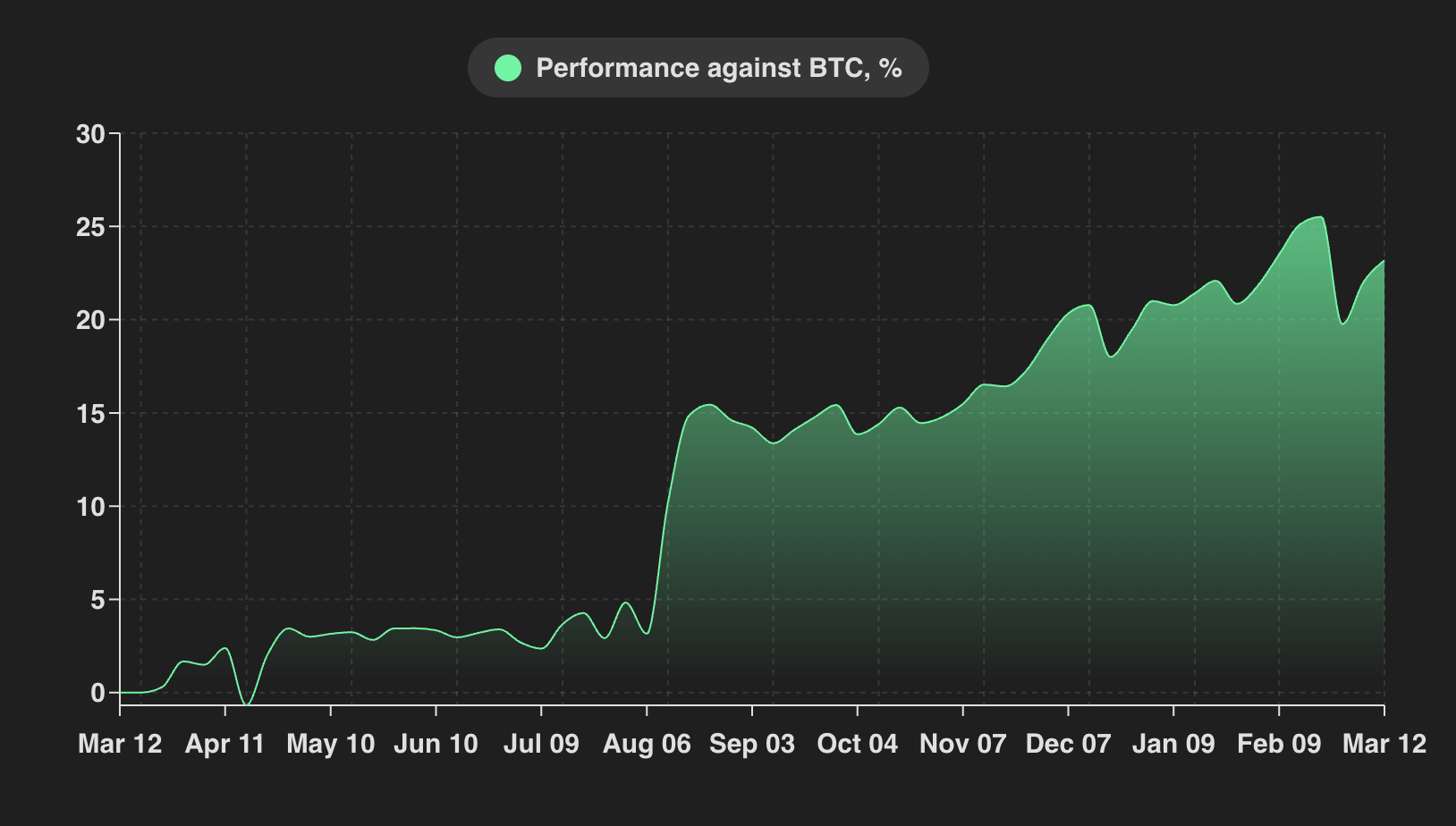
Backtested performance over the last year (March 2024 – March 2025) is 23.2% against BTC. The strategy shows smooth performance over different market conditions with a Sharpe ratio of 2.8. A substantial rise occurs around August 2024, linked to external macroeconomic factors (BOJ rate hike), followed by a swift market recovery during which we earned a lot from increased trading fees (volatility harvesting). Overall, the strategy demonstrates strong performance, protecting capital and capturing significant gains during volatile periods.
Inception risks
Inception inherits the underlying risks of the Nova, Astrid, and Polaris strategies, specifically:
- Smart contract risk: exposure to vulnerabilities in Lumis vault contracts, underlying protocols (Morpho, Uniswap V4, Opyn), and EigenLayer sequencer integrations.
- Liquidation risk: possibility of collateral liquidation in leveraged strategies (Polaris) during extreme market volatility.
- Oracle and execution risk: dependency on reliable price feeds and derivatives market liquidity, impacting hedge effectiveness.
- Counterparty risk: reliance on trusted custodians and external security providers in institutional permissioned deployments.
To mitigate these risks, Lumis applies diversified collateral management and automated risk monitoring through the app-specific sequencer, executing conditional rebalances:
- Time-based: scheduled weekly rebalances.
- Price-based: triggered when price deviation exceeds 15%.
These structured rebalancing conditions maintain the targeted portfolio composition, ensuring controlled risk exposure and avoiding over-allocation to higher-risk strategies.
App-specific sequencer
The core execution engine of Lumis synchronizes directional and delta-neutral vaults to optimize real-time hedge execution and rebalance flows.
Trade balancer & automated hedging: dynamically routes trade flow between vaults for efficient swap execution and minimal slippage. A long position adjustment automatically triggers short position minting, effectively netting hedge positions internally (an OTC trade between vaults) and minimizing unnecessary external trades.
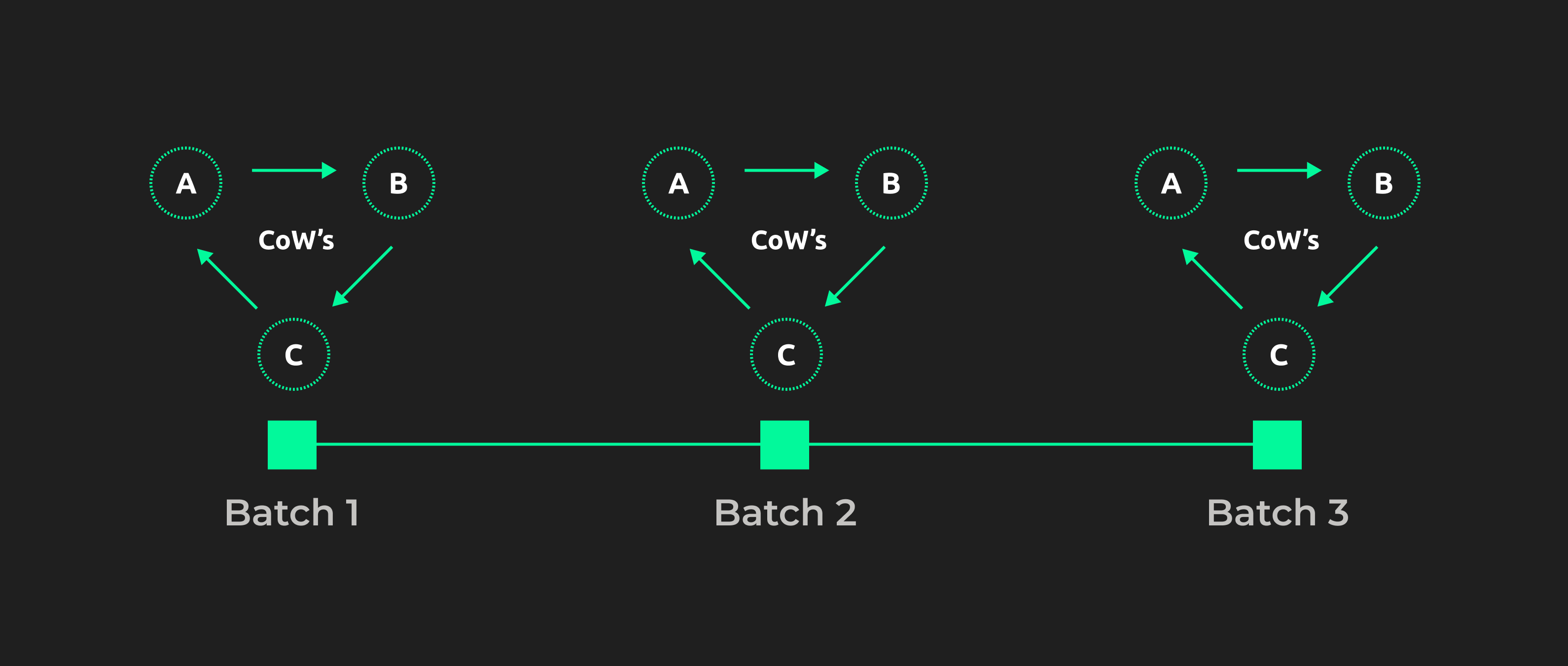
Vaults network: provides a global rebalance schedule (hourly, daily, weekly, etc.) so curators can submit their vaults for coordinated rebalancing execution via coincidence-of-wants (CoW) batch auctions.
Security & decentralization: the sequencer operates within EigenLayer's decentralized execution environment, ensuring continuous availability and economic security guarantees against centralization risks.
Deployment modes:
- Permissionless: fully decentralized, for retail and general institutional clients.
- Permissioned: an institutional-grade solution, holding all vault funds with trusted custodians and performing transaction pre-validation checks against manipulations or potential attacks using external security services (TRM Labs, Chainalysis, Hacken Extractor, etc).
This dual-mode design provides institutions with compliance certainty and maximum security assurance — resulting in a synchronized, decentralized liquidity network optimized for swaps, hedging, and coordinated rebalancing, directly addressing traditional scalability bottlenecks and security concerns.
Use case
Lumis offers a non-custodial liquidity system where curators can deploy customized structured products leveraging our modular templates tailored for their clients' needs, while instantly benefiting from network-wide shared trade flow and coordinated rebalancing execution.
The mutually beneficial nature of our vaults enables a liquidity network effect for any yield-bearing asset.
For example, in the case of Ethena's sUSDe: the Ethena team, as a curator, can deploy a Nova vault for the sUSDe-USDT pool on Uniswap V4 — boosting liquidity for both spot and lending markets. This is especially important for the efficient execution of leveraged yield farming strategies.
With the deployment of our other strategies, LPs will also be able to preserve directional exposure to BTC while farming both sUSDe yield and amplified Uniswap trading fees with built-in impermanent loss hedging. Further, Pendle's principal/yield token separation can be added on top to offer clients diverse dollar yield products in the future crypto dollar wars.
Business model
Revenue is generated via sequencer-level trading fee sharing: curators deploying structured vaults share a portion of their collected trading fees with the protocol in exchange for infrastructure, aggregated liquidity, MEV-protected execution, and coordinated rebalancing.
Generated protocol fees are directed towards buying back Lumis tokens from the open market. Rather than burning tokens, Lumis utilizes them to actively reinvest in ecosystem development — funding vault curators, incentivizing new strategy creation, expanding integrations, and continually driving liquidity network effects.