Rehypothecation vault
Leveraged long 3× / short 2× looping on Euler, reused as ETH-USDC liquidity — 1× net ETH exposure, ~3× the trading fees, impermanent loss hedged
Contents
Abstract 1. Beyond V3 LP tokens 2. Mechanism 3. Dynamic liquidity 4. Performance 5. Risks and liquidation defenses 6. The delta-neutral variantAbstract
Intent-based Uniswap V4 hooks let custom trading logic run inside the swap, removing the hard restrictions of previous-generation LP tokens. This vault uses that freedom for liquidity rehypothecation: it holds a leveraged long 3× and short 2× position on the Euler lending protocol, built via looping, and reuses the combined collateral-and-debt state to provide liquidity for the ETH-USDC pool. Net exposure stays 1× — the vault tracks plain ETH holding — while the enlarged balance sheet supplies roughly 3× the liquidity, and so collects roughly 3× the trading fees, of the original portfolio. The same design generalizes to Morpho markets on the stablecoin side (Nova).
1. Beyond V3 LP tokens
With intent-based hooks that execute custom trading logic inside the swap, we are no longer limited by the hard restrictions of previous-generation LP tokens such as Uniswap V3 NFTs — and can apply novel mechanisms to one of the oldest DeFi problems: impermanent loss.
Instead of providing liquidity in the traditional Uniswap V3 style, the vault creates a combination of leveraged long 3× and short 2× positions on Euler, achieved via looping, and uses those positions — the collateral and debt state — to provide liquidity for the ETH-USDC pool.
2. Mechanism
The net exposure of the combined position is 1×, exactly as if the vault simply held ETH. But because both collateral and debt are significantly larger than the initial ETH portfolio, the vault can quote significantly more liquidity — and therefore collects higher trading fees relative to the original portfolio.
Once the long and short legs are established, the vault provides liquidity through an internal trading function similar to the Uniswap V3 concentrated-liquidity model.
3. Dynamic liquidity
Unrestricted by Uniswap V3 mathematics, the vault prices liquidity off its total leveraged position value and applies a liquidity multiplier that adjusts to market conditions — implied volatility, or the Euler USDC interest rate as a trend indicator. The logic mirrors perp funding-rate behavior (the Ethena yield): a higher USDC rate signals higher demand for decentralized leverage, hence more bullish short-term expectations.
4. Performance
The result is a synthetic ETH portfolio that closely follows pure ETH holding, effectively mitigating impermanent loss.
- Within a profitability range of ±10% ETH price change, the vault earns up to 2% yield from trading fees per 3-day rebalancing period.
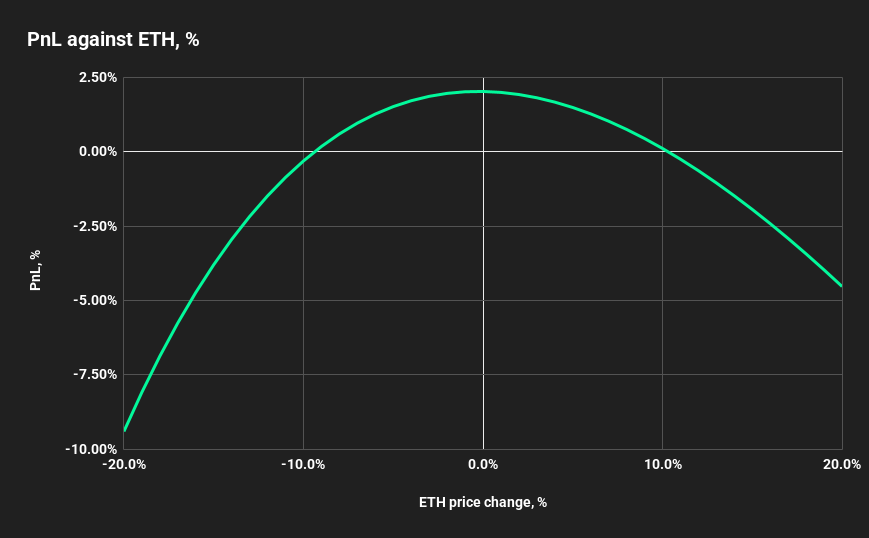
- Backtested over two years (01.01.2023 – 01.01.2025): 69.8% against ETH (34.9% APY) and 193.4% against USDC.
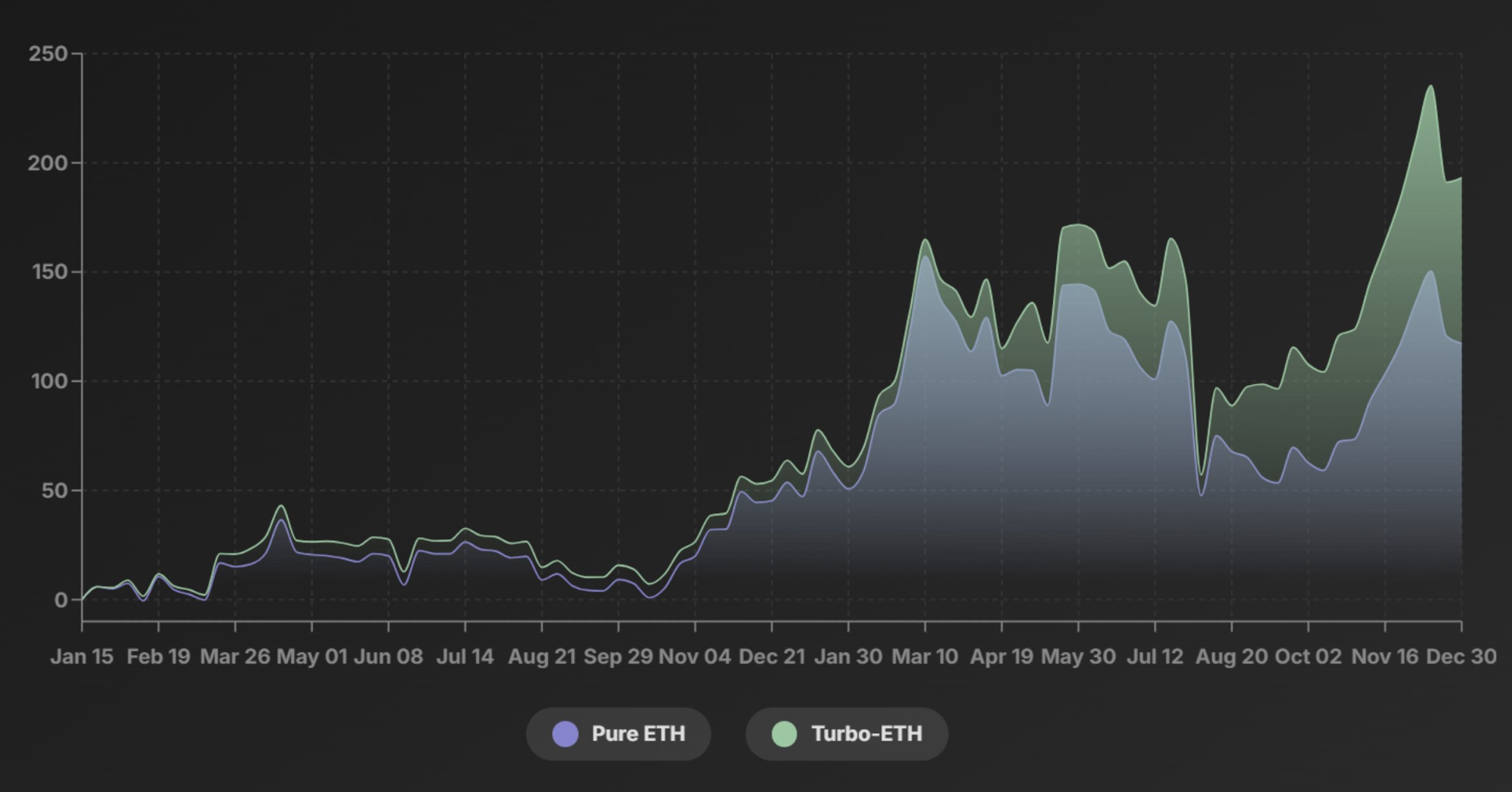
The strategy performs best in volatile bull markets — collecting outsized fees, as during the post-election surge. In bear markets it dynamically de-risks the position; in low-volatility crab markets it sits inside the profitability range and simply collects fees.
5. Risks and liquidation defenses
Higher LP returns come with leverage, and leverage brings liquidation risk. Two mechanisms defend against it:
- Dynamic collateral/debt shift — the strategy atomically shifts collateral and debt between the long and short legs during swaps, optimizing the LTV curves and maintaining vault stability.
- Conditional rebalances — time-based (once per 3 days) and price-based (after an ETH move greater than 10%).
Together these maintain the synthetic ETH exposure with minimized impermanent loss while keeping the system clear of liquidation.
6. The delta-neutral variant
Applying the same principles with a leveraged long 3× and short 3× position yields a delta-neutral vault that farms boosted trading fees regardless of ETH price direction.